

Subotica Music School was founded by the Town Council in 1868. At the time, it was part of the local grammar school and had three departments: Singing, Violin and Cello. Each department had its own teacher in charge: Vince Souschek, Géza Allaga and Leonhard Barbaro. The Wind Department was established in 1874.
The first teacher to hold a university degree was Ferenc Gaál, who served as the Head of the institution from 1 October 1882 until his death. He was an excellent pianist and a respected expert. In 1890, he established the Piano Department.
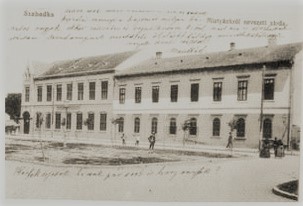
In 1907, Ernő Lányi became Head of the Music School. He already had extensive experience as a performer, pedagogue and organizer and was well known in many European cities. He established a music library and a score library and provided the school with new musical instruments. In 1914, during his tenure, the Music School moved to the Hungarian House in Strossmayer Street, where it is still located today. In 1908, he founded the Subotica Philharmonic Orchestra, which greatly contributed to the town’s musical life and attracted world-renowned artists such as Béla Bartók, Pablo Casals and many others.
After the First World War, Subotica became part of the Kingdom of Serbs, Croats and Slovenes, and the Music School was headed by Cvetko Manojlović. He began his musical education in Subotica and graduated in Leipzig. In 1899, together with Stanislav Binički and Stevan St. Mokranjac, he established the first Serbian music school in Belgrade, where he became the first prominent piano teacher in Serbia.
After Cvetko Manojlović retired, Hermann József, a violin teacher, succeeded him as Head of the Music School. During the Second World War, the school was headed by Szemlér István, who graduated as a violin teacher from the Academy of Music in Budapest.
Following the war, the first Head of the Music School was Straka Dezső, who was succeeded by Milko Cora (born Pataki) in 1947.
In the post-war period, Subotica had a vibrant musical life, and the Music School played a vital role in the town’s cultural events, organizing many of its concerts. In addition to music education, students could also study ballet and acting as part of opera productions. As a result, students were able to perform almost the entire opera Nikola Šubić Zrinski by Ivan Zajc on the occasion of the Music School’s 80th anniversary, on 31 March 1948.
Milko Cora was succeeded by Josip Peić (1968–1975), followed by Géza Sándor (1975–1979), István Balázs Piri (1979–2002), Katarina Skenderović (2002–2004), István Antal (2004–2012), and Edit Barlai (2012–2017). Dragana Nikolić has served as Head of the Music School since 2017.